Showing posts with label paul george. Show all posts

Tuesday, March 7, 2017

Usage vs efficiency for NBA's highest-usage players

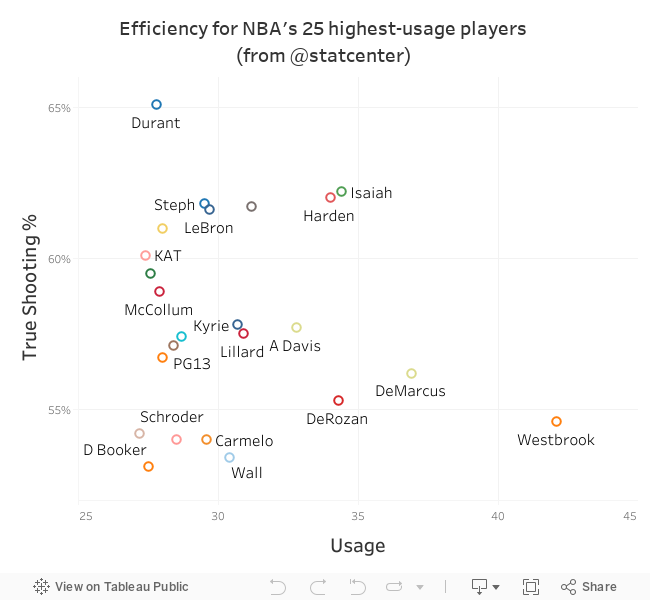
Here's how the NBA's 25 highest-usage players stack up in efficiency for the 2016-17 season (as of March 7):


It's hard to describe what Russell Westbrook is doing, except to say he's simply playing a different sport than everyone else. Has anyone every combined impact and inefficiency to this extent before?

Wednesday, April 2, 2014

Who should win Defensive Player of the Year?

Since practically the first game of the season, it's seemed like the Defensive Player of the Year award was headed to Roy Hibbert. And his case remains strong - Indy still leads the NBA in defensive efficiency, and Hibbert's interior presence is the most integral piece of that.

But there are worthy challengers. I'm going to look at four candidates here - Hibbert, Joakim Noah, Dwight Howard, and DeAndre Jordan. (I thought long and hard about other guys, including Serge Ibaka, but ultimately I think these four stand above the rest based on a combination of individual and team success.)

Let's start with some data on one-on-one defense:


In terms of one-on-one defense, Hibbert is clearly the best inside - he's tops in field-goal percentage at the rim, and in isolation plays. But Noah is exceptional covering in space, both against the screener / roller in pick-and-rolls, and guarding spot-up shooters. Not surprisingly, he's also asked to play out in space far more often than Dwight or Roy. That's obviously a function of the defensive scheme, so we're not penalizing Howard or Hibbert for it, but it does point to Noah's versatility.

Of course, DPOY is (or at least should be) about more than just one-on-one field goal percentage. Next, let's look at how many minutes these guys are actually on the floor, and how they're doing on defensive rebounding (since an opponent's possession isn't over until you secure the ball).


Hmmm, tough times for Hibbert, and the real strength of Jordan's case. Dwight, Joakim and especially DeAndre all play significantly more minutes than Roy, and are all far better defensive rebounders. This is a bit tricky, because Hibbert's per-game rebounding totals are going to be affected by the presence of David West, Lance Stephenson, and Paul George, all of whom rebound at above-average clips for their positions. But the last chart above, based on SportVU data, shows that Hibbert also simply doesn't snare as many rebounds even when he's in prime position (within 3.5 feet of the rim). And his defensive rebounding rates have declined each of the past three seasons, even though West is playing fewer minutes himself this season.

Finally, let's look at team performance, both with these four on the court and off.


Yeah, Hibbert and Noah are awesome. They're both taking fantastic defenses to an entirely different level when they're on the court. I'm shocked by Jordan's stats here - the Clips don't exactly roll out stud defenders when DJ goes to the bench. Speaking of stud bench defenders, you have to take Dwight's position on this chart with a generous grain of salt because he's backed up by the superb Omer Asik. And he's often covering for three minus defenders around him, including James Harden, who went from Thanksgiving to St Patrick's Day without giving a single crap about defense.

So who should win the Defensive Player of the Year?

Man, is it tough to select one guy. Hibbert is the most dominant defender inside, and the lynchpin of the best overall defense. But he plays the fewest minutes and has really faltered on rebounding. Dwight is still a very good all-around defender, but he's not at the all-time level he set a few years ago in Orlando. And Jordan, while vastly improved in coverage and the league's undisputed best rebounder this year, still has inconsistencies at the rim and in pick-and-roll situations.

Which leaves us with Noah - the candidate with the fewest blemishes. He defends the entire court exceptionally well, he's been durable, and he's captained the second-best defense in the NBA even after losing ace perimeter defender Luol Deng mid-season.

Time to celebrate, Jo!


Data sources: NBA.com/stats, basketball-reference.com, Synergy Sports
Wednesday, March 26, 2014

Recent scoring margin + schedule strength for every team

When at ESPN, John Hollinger found (not surprisingly) that recent performance mattered more in determining a team's current strength than dated performance from early in the season. He reflected this in his Power Rankings by including both team scoring margin and strength of schedule (SOS) over their most recent 25% of games, as well as season-long margin and SOS.

So how does every team stack up right now in recent performance?


Having trouble seeing this chart? Click here.)

Some takeaways:

  • It's interesting that so much attention has been paid to the Heat's recent malaise, when the Pacers' woes have been both deeper and more sustained. Indiana is 21st in offensive efficiency for the season as a whole, and bottom-five over the past month. And that's despite paying a Charmin-soft schedule. Paul George and Roy Hibbert have both really cratered since the first two months. It's not an exaggeration to say this offense is really only good at one thing right now: getting to the free-throw line (and hitting those freebies at an excellent 78% rate).
  • Most of the teams in the top and right sections won't surprise most viewers, but... holy Bobcats! As Zach Lowe detailed this week, the Al Jefferson-fueled offense and a shockingly elite defense have combined to create a real, viable playoff team. This squad won't be an easy out for anyone in the playoffs.
  • Hmmm, lots of blue circles in the "good areas", and lots of red circles in the bad areas. The gap between the East and West has actually closed just a teensy bit over the past month or so, but it's still ginormous.
  • I don't know what to say about the Sixers. Their recent scoring margin is an entire standard deviation lower than every other team in the NBA. In case you're not well-versed in statistics, that is comically, awe-inspiringly awful. They're the worst offensive team by a mile, and since the calendar turned to 2014, also the worst defense. Someday Michael Carter-Williams is going to be part of a really good team, but I suspect he'll still be haunted by nightmares of 2013-14.
Data source: Hollinger Power Rankings

Tuesday, March 11, 2014

How this year's title contenders compare to past NBA champions

There are, by my count, eight legitimate (or semi-legitimate) title contenders in the NBA this year - seven teams that are winning more than 2/3 of their games, plus the Warriors who are 7th in overall efficiency. I wanted to look at how those contenders compare to the past ten NBA champions in terms of offensive and defensive efficiency.

I'm using offensive (defensive) efficiency index, which basically means comparing each team's points scored (allowed) per 100 possessions to their league average that year. A higher offensive index (and lower defensive index) is better.

Here we go - and remember, teams want to be as close to the top right corner of this chart as possible:

(Having trouble seeing the chart? Click here.)

Some takeaways:
  •  Everyone considers the 2014 Heat legitimate title contenders - and rightfully so, given their track record and ability to seemingly "turn it on" in the playoffs. (And presumably more minutes for LeBron James and Dwyane Wade.) And it seems an increasing number of fans and media are placing the Clippers and Rockets into the contender bucket as well, especially with how well Blake Griffin played in Chris Paul's absence, and Dwight Howard's impact on the Rockets' half-court D. But it's worth noting that no champion in the past 10 years as been as average on defense as the 2014 Heat, Clips, or Rockets. Every one of those recent champs was at least 4% better on defense than the league average, and half of them were at least 7% better than average. The Clips are actually tied with the 2006 Heat right now, so it's certainly possible they overtake them soon. Now for the optimists out there, take a gander at those three teams on offense -  they're more efficient compared to their peers than any recent champ, except for last year's Heat squad. This year's playoffs could be more offense-first than any recent edition.
  • Except that Indiana is prominently involved. This year's Pacers aren't LIKE the 2004 Pistons - they ARE the 2004 Pistons. The raw numbers (and the early-season ascent of Paul George) might mask that fact, but consider how the league has evolved over the past decade. The average team in 2004 scored 102.9 points per 100 possessions, and in no season since then has the average been below 104.6 pts / 100 possessions. This year, the league average is a hair under 106 pts / 100 possessions. When you account for more dynamic offense across the board, Indiana this year looks even better on defense (thanks, Roy Hibbert!) - and even worse on offense.
  • The Spurs and Thunder. I mean, what is there to say? They've probably been the most impacted by injuries (Russell Westbrook, Tony Parker) of any of this year's top 8, and yet they still sport the best balance of elite offense and really superb defense. I don't think most fans recognize how incredible Tim Duncan has been on both ends of the court this year - he's top-five in the NBA in both blocks and defensive rebounding while leading the Spurs in total minutes. As for OKC, I'm really intrigued by the proximity of this year's squad to the 2009 Lakers on this chart - that seems like an excellent comp, in terms of one elite scorer (though Kevin Durant is more efficient than Kobe Bryant five years ago), an All-Star #2 on offense, and an underrated smothering defense.
  • Maybe I should stop calling the Blazers a contender. Adjusted for pace and season, they're less efficient on defense than the "Seven Seconds or Less" 2006 Suns. And their Damian Lillard-fueled offense is outstanding... but still only 4th-best in the NBA. That's not a recipe for winning two payoff rounds, much less four.
  • The Warriors, though - OK, they have to make the playoffs first. Fine. But the defense is right in line with championship standards. On the other side of the ledger, raise your hand if you thought a Stephen Curry-led offense would be less relatively efficient than the 2005 Spurs.
Data sources: NBA.com/stats, basketball-reference.com